
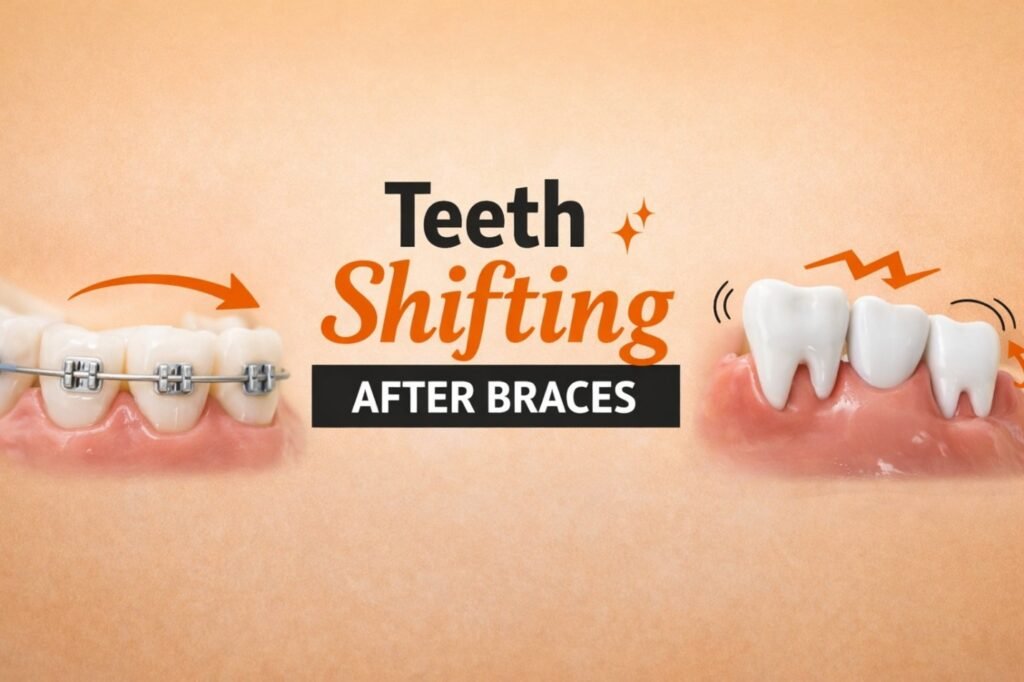
You spent months—maybe years—in braces. You sat through adjustments, dealt with sore teeth after every tightening, and counted down the days until removal. And then the braces finally came off. Your teeth looked perfect. You felt incredible.
Fast forward a few months or a couple of years, and something feels off. A lower tooth has twisted slightly. There’s a small gap opening up that wasn’t there before. Your bite doesn’t feel quite right.
You’re not imagining it. Teeth shift after braces more often than most people realise. A study published in the American Journal of Orthodontics and Dentofacial Orthopedics found that some degree of post-treatment tooth movement occurs in the majority of orthodontic patients, even those who wore retainers initially. The good news? Understanding why this happens puts you in a much stronger position to prevent it.
Why Do Teeth Shift After Braces?

Teeth are not rigidly fixed in the jawbone. They’re held in place by periodontal ligaments — living, elastic fibres that connect each root to the surrounding bone. These ligaments are what make orthodontic movement possible in the first place. During treatment, braces gradually remodel the bone and stretch these fibres into new positions. But once the braces come off, those ligaments still carry a memory of where the teeth used to sit. Over time, they pull gently toward the original alignment. This is a normal biological response, not a sign that something went wrong — and it’s exactly why wearing a retainer after treatment isn’t optional.
Several factors accelerate this:
- Periodontal ligament memory pulling teeth toward their original positions
- Ongoing jaw growth and bone remodelling, particularly in younger patients
- Everyday pressure from your tongue, lips, and cheeks against the teeth
- Habits like grinding, clenching, or mouth breathing
- Wisdom teeth eruption, which can crowd the lower arch
It’s not a matter of whether your teeth will try to move—they will. The real question is whether you have the right retention strategy in place to stop them.
How Quickly Can Teeth Move?
Faster than you’d expect. The first six months after braces removal is the highest-risk period. Bone around your teeth hasn’t fully consolidated yet, and the periodontal fibres are still adapting. During this window, even skipping your retainer for a few nights can allow noticeable movement.
But the risk doesn’t disappear after six months. Teeth continue to shift gradually throughout your life as part of normal ageing. The lower front teeth are especially prone to crowding over time. Patients who wore their retainers faithfully for the first year and then stopped altogether often notice changes within a year or two of discontinuing.
The bottom line: retention isn’t a short-term commitment. It’s a long-term one.
The Role of Retainers in Keeping Teeth in Place

If braces do the work of moving your teeth, retainers do the work of keeping them there. After your braces come off, the bone and soft tissue around your teeth need time to remodel and stabilise. A retainer holds everything in position while that biological process completes.
Without a retainer, your teeth have no external support. The ligament memory kicks in, pressure from surrounding soft tissue does its work, and teeth begin to drift. This is true regardless of how long you wore braces or how skilled your orthodontist was. The biology is the same for everyone.
Most orthodontists now recommend indefinite retainer use. That doesn’t mean wearing a retainer 24 hours a day for the rest of your life—but it does mean nightly wear for the long haul, at minimum.
Types of Retainers: Which One Is Right for You?
There’s no single retainer that works best for everyone. The right choice depends on your specific case, your lifestyle, and your compliance habits.
Fixed (bonded) retainers are thin wires permanently glued behind your front teeth. They work around the clock without any effort on your part, which makes them excellent for patients who worry about forgetting to wear a removable retainer. The trade-off is that they require careful flossing and can occasionally debond without you noticing.
Hawley retainers are the classic removable type with a wire that sits across the front teeth and an acrylic plate resting against the palate. They’re durable and adjustable, but they’re also visible when worn and can feel bulky.
Clear retainers (Essix-type) look similar to clear aligners—thin, transparent trays that fit snugly over your teeth. They’re discreet and comfortable, though they do wear out over time and need replacing every 12–18 months.
Many patients benefit from a combination: a fixed retainer on the lower arch paired with a removable clear retainer on the upper arch. I tailor this recommendation to each patient after evaluating their bite, tooth position, and personal preferences.
Signs Your Teeth Are Shifting
Tooth movement can be subtle at first. Here are the early warning signs to watch for:
- Your retainer feels tighter than usual or no longer fits comfortably
- Visible crowding or overlap developing in the front teeth
- New gaps appearing between teeth that were previously closed
- A change in how your upper and lower teeth meet when you bite down
- Increased food trapping between teeth that didn’t happen before
If your retainer is feeling snug but still fits, that’s actually a signal it’s doing its job—your teeth tried to move, and the retainer pushed them back. But if the retainer no longer seats properly, that’s a sign teeth have already shifted beyond what it can correct, and you need professional attention.
Can Shifted Teeth Be Fixed Without Braces Again?
In many cases, yes. If the relapse is mild to moderate, clear aligners are often an effective and far more convenient alternative to a second round of braces. Short-course aligner treatments can address minor crowding, small gaps, and slight rotations in a matter of months rather than years.
For patients with more significant shifting, a more comprehensive aligner plan or even targeted fixed braces on select teeth may be necessary. The specifics depend on the nature and extent of the movement.
The earlier you address the issue, the simpler and less expensive the correction tends to be. Waiting until crowding becomes severe only makes retreatment more complex.
Fixed (bonded) retainers are thin wires permanently glued behind your front teeth. They work around the clock without any effort on your part, which makes them excellent for patients who worry about forgetting to wear a removable retainer. The trade-off is that they require careful flossing and can occasionally debond without you noticing.
Hawley retainers are the classic removable type with a wire that sits across the front teeth and an acrylic plate resting against the palate. They’re durable and adjustable, but they’re also visible when worn and can feel bulky.
Clear retainers (Essix-type) look similar to clear aligners—thin, transparent trays that fit snugly over your teeth. They’re discreet and comfortable, though they do wear out over time and need replacing every 12–18 months.
Many patients benefit from a combination: a fixed retainer on the lower arch paired with a removable clear retainer on the upper arch. I tailor this recommendation to each patient after evaluating their bite, tooth position, and personal preferences.
Tips from Dr Pravin Shetty to Maintain Your Smile
Wear your retainer every night. Make it as automatic as brushing your teeth. If it’s not part of your routine, it won’t happen consistently.
Replace clear retainers before they crack or warp. A worn-out retainer isn’t holding your teeth properly, even if it still fits.
Store retainers in their case, not wrapped in a napkin. Lost retainers are the number one reason patients stop wearing them.
Schedule regular dental check-ups. Your dentist can spot early shifting before you notice it yourself.
Address grinding or clenching. If you clench at night, a night guard or combined retainer–splint may be a better option for you.
Act quickly if something feels off. A tight retainer is manageable. A retainer that doesn’t fit at all means you’ve waited too long.
When to Visit Your Orthodontist
Don’t wait for a problem to become obvious. Schedule a visit if your retainer stops fitting, if you notice any visible changes in tooth position, or if it’s been more than a year since your last orthodontic check-up. Early intervention is always easier, faster, and more affordable than correcting advanced relapse.
Your orthodontic result was an investment of time, money, and patience. Protecting that investment takes minimal effort—but it does take consistency.
Frequently Asked Questions
Yes. Minor settling is expected in the first few weeks as your bite adjusts. However, ongoing or visible shifting beyond that initial period usually indicates inadequate retainer wear and should be evaluated.
The honest answer is: for as long as you want your teeth to stay straight. Most orthodontists now recommend nightly retainer wear indefinitely. Teeth have a lifelong tendency to shift, and the retainer is the only thing preventing that.
Do not force it in. Contact your orthodontist or dentist as soon as possible. If teeth have shifted, you may need a new retainer made to fit the current position, or you may need a short course of treatment to re-align before a new retainer is fabricated.
In most cases of mild to moderate relapse, yes. Clear aligners are an excellent option for correcting post-brace shifting without going through traditional braces again. Treatment times are often significantly shorter—sometimes just three to six months.